Seychelles: what you need to know
- The Seychelles are more than 100 islands in the Indian Ocean, but tourists go on holiday to only 3 inhabited islands (Mahé, Praslin and La Digue). There are resort islands here too, but there are also resorts on the main big islands. Mahé is the island where all international flights land, and it is also one of the 3 tourist islands.
- The islands are not surrounded by an atoll of coral reefs. You need to choose a beach carefully here, because the presence of waves and seaweed in the water depends on the season and the winds. Many beaches have various currents, and you should remember about rip currents, which can easily carry an adult out to the open sea. As a result, snorkeling from the shore can be difficult because of the waves and seaweed pollution.
- The coasts of all the inhabited islands offer a meager choice for snorkeling; you need to book snorkeling and diving in the open sea, off the shores of the uninhabited islands. You will rarely meet a sea turtle here, let alone other marine creatures...
- The big supermarket is on Mahé - STC - but there are plenty of small shops everywhere where it is easy to buy lots of groceries, including imported ones from all over Europe! In the Seychelles it is convenient to rent self-catering accommodation (with your own kitchen), since the shops have quite a lot of products. Eating in restaurants is "expensive" and "very expensive")
- Accommodation is available for any budget - simple hotels, apartments, luxury rooms in elite resort hotels. But the minimum budget is around 200 euros per night. The main price segment is 500-1000 euros per night.
- There is little fruit on the islands, very little, both in quantity and variety. Mostly bananas and small "pea" mangoes) Coconuts are available too.
- On Mahé and Praslin renting a car is a must; without it there is nothing to do here. It is sometimes a 10-40 minute drive from the hotel to the beach. Keep in mind that traffic here drives on the left, in right-hand-drive cars. The roads are super narrow, just like in Italy, but here, instead of a sidewalk, the roadside in many places has drop-offs - ditches for rainwater) On La Digue there seem to be no cars, but you need a bicycle, otherwise it is a 30-50 minute walk to the beach))) If you can't ride a two-wheeled bicycle, no problem, there are three-wheeled ones. But there is one little "BUT" - the terrain is hilly / mountainous, and that is yet another quest - cycling uphill in the equatorial heat)...
- You hardly need cash here, only 100-200 euros for 2 weeks for fruit and small things. Everything else is paid by card.
The Maldives: what you need to know
- The Maldives are thousands of islands in 26 coral reef atolls, but tourists visit 10 main islands (Malé + Hulhumalé, Thoddoo, Rasdhoo, Maafushi, Ukulhas, Vaadhoo, Baa Atoll with its islands, and others) and expensive elite closed-type resorts - separate islands. Malé is the island where all international flights land. It is worth staying here only on the day of arrival and departure, so that the transfer to the next islands goes smoothly and without rushing. Malé and Hulhumalé should not be considered as tourist destinations at all.
- All the islands or groups of islands are surrounded by an atoll - a coral reef. This makes the holiday very comfortable: it is easy to snorkel and you need not fear currents.
- From the shore of almost every island there is a superb choice for snorkeling. Sea turtles are not rare here, even from the shore) Diving and snorkeling excursions outside the reefs are a delight - tiger sharks, mantas and a huge number of ocean inhabitants.
- In the Maldives there are not only no big shops, but even the small shops carry almost no range of groceries. At best you will have to live on oatmeal and instant noodles... Accommodation with a kitchen simply does not exist in the Maldives. Accommodation here is rented with breakfast and dinner included in the price. For lunch, fruit will be enough, which you will also have to search for on the island) As an option, you can rent accommodation with breakfast only and go to a restaurant for dinner. Prices here are not expensive, but do not expect Michelin quality)
- Accommodation in the Maldives falls into two categories: super elite - closed resorts - a hotel / an island - and guesthouses run by locals. Until 2011 there were only resorts in the Maldives, and then locals were allowed to host tourists in their guesthouses. The main flow of visitors started coming in 2014.
- There is little fruit on the islands, very little, both in quantity and variety. Mostly bananas and papaya. Coconuts are available too.
- On any of the islands it is a 5-10 minute walk to the beach. No transport is needed, and there is almost none here)
- There is really nowhere to spend money here, but if you pay for an excursion and fruit, it is better to have cash. Payment in restaurants and shops may also be in cash!
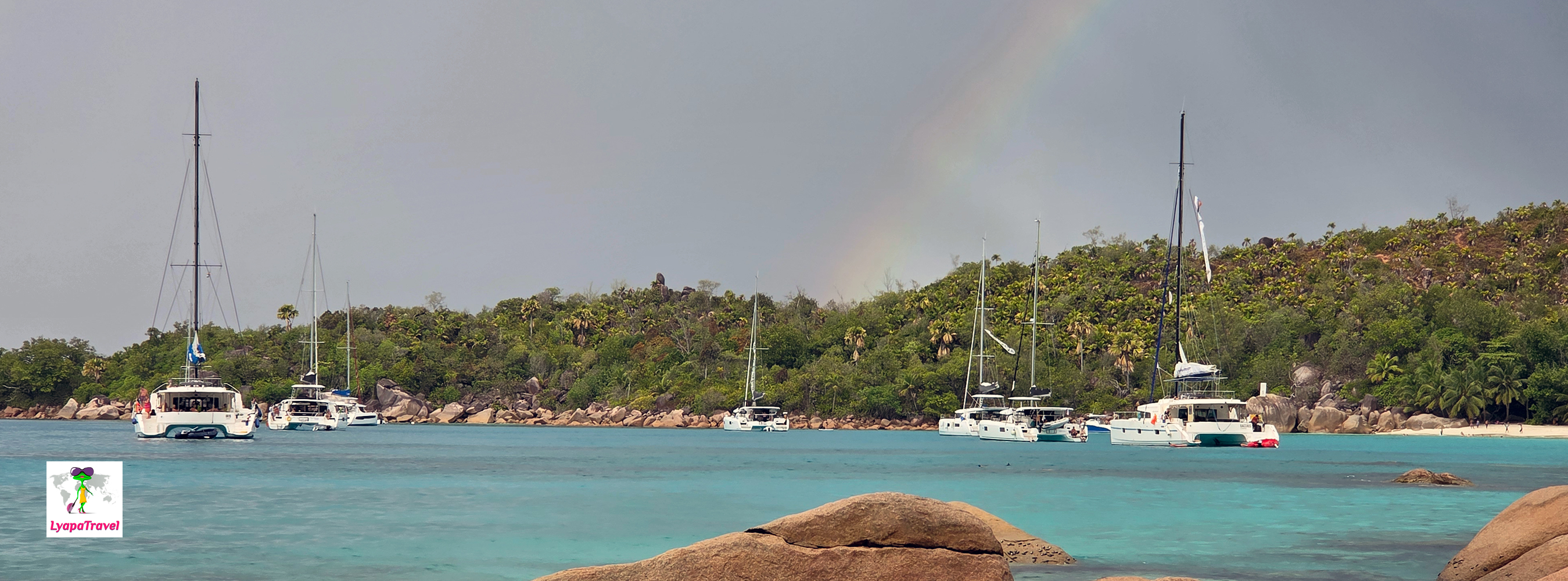
rainbow in the Seychelles
Image
Countries
Add new comment